An essay evaluation sheet is here:
https://www.dropbox.com/s/9sxz5wmf3wjwzbb/Essay%20Evaluation%20Sheet.doc
Not all these concerns apply to all essays: e.g., expository essays that explain a theory or point of view do not have a thesis.
Showing posts with label writing. Show all posts
Showing posts with label writing. Show all posts
Friday, September 13, 2013

Wednesday, July 3, 2013
REPOSTING: From Business Insider Magazine
America Is Raising A Generation Of Kids Who Can't Think Or Write Clearly

Parents don't read to their children as much, K-12 humanities teachers are not as well-trained as STEM ones, federal funding for international education is down 41% over four years, and many college students graduate without being able to write clearly.
Although humanities degrees are not in total freefall, the bigger problem centers on the decline in pre-college humanities education and in the liberal arts curriculum in college.
Humanities get a tiny fraction of the federal funding that STEM programs do. Many schools, public ones in particular, are already under huge financial pressure, so they're going to focus more of their energies on the things that they can get others to pay for:

That means fewer offerings, less faculty, and a decline in the sort of introductory and mandatory classes that used to be standard in college.
The result is not only relatively fewer humanities majors but also a generation of students who get out of school and don't know how to write well or express themselves clearly.
The New York Times' Verlyn Klinkenborg, who has spent time teaching writing to both undergrads and graduate students at places like Harvard, Yale, Pomona, Sarah Lawrence, and Columbia's Graduate School of Journalism, reports that kids are shockingly ill-prepared:
Each semester I hope, and fear, that I will have nothing to teach my students because they already know how to write. And each semester I discover, again, that they don’t.
They can assemble strings of jargon and generate clots of ventriloquistic syntax. They can meta-metastasize any thematic or ideological notion they happen upon. And they get good grades for doing just that. But as for writing clearly, simply, with attention and openness to their own thoughts and emotions and the world around them — no.
Those are undergraduate and even graduate students at some of the top colleges and universities in the country who have chosen to focus on writing to a certain extent. Things are presumably even worse elsewhere.
A 2010 study from Richard Arum and Josipa Roksa found that students majoring in liberal arts fields see "significantly higher gains in critical thinking, complex reasoning, and writing skills over time than students in other fields of study."
De-emphasizing, de-funding, and demonizing the humanities means that students don't get trained well in the things that are the hardest to teach once at a job: thinking and writing clearly.
CEOs, including Jeff Bezos, Logitech's Bracken Darrell, Aetna's Mark Bertolini, and legendary Intel co-founder Andy Grove emphasize how essential clear writing and the liberal arts are. STEM alone isn't enough. Even Federal Reserve chair Ben Bernanke recently gave English majors a shout-out.
The point is that good writing isn't just a "utilitarian skill" as Klinkenborg puts it but something that takes a great deal of practice, thought, and engagement with history and what other people have written.
Let's hope that argument keeps the field alive.
Read more: http://www.businessinsider.com/the-war-against-humanities-2013-6#ixzz2Xz86YaF2
Monday, July 1, 2013
REPOSTING: An article about how philosophy offers real-world job skills: clear writing, thinking and communication!
MONDAY, JUL 1, 2013 08:45 AM EDT
 Jean-Paul Sartre
 It must be summer. In anticipation of fall course schedules, several people have asked what I think someone who wants to be a journalist should study.
Be employable, study philosophy
The discipline teaches you how to think clearly, a gift that can be applied to just about any line of work
TOPICS: THE TYEE, PHILOSOPHY, UNEMPLOYMENT, NEW YORK TIMES, POSTMODERNISM, JOURNALISM, BUSINESS NEWS, LIFE NEWS
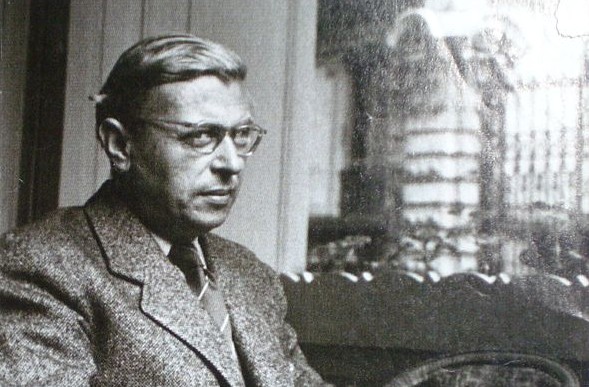 Jean-Paul Sartre
This piece originally appeared on The Tyee.
It must be summer. In anticipation of fall course schedules, several people have asked what I think someone who wants to be a journalist should study.
A few years ago I realized my favourite answer — not journalism — was depressing for someone who had already reserved a seat for himself or his child at one of Canada’s more than 50 journalism programs.
That’s right: 50. According to J-Source, the journalism website, there are 1,600 J-students at any given time preparing to work in an industry that has lost anywhere from one-third to half of its jobs in the last decade. The U.S. is always slightly ahead of us in trends, and in June the Chicago Sun-Times fired its entire photography staff, replacing it with iPhones for the remaining reporters. Since most reporters shoot about as well as most photogs spell, I’m breathlessly awaiting the next report of their declining circulation.
But apparently those sorts of comments were “killing the dreams” of future journalism students, so I’ve stopped saying things like that. I figure if they don’t read enough news to know that media outlets are dropping faster than Stephen Harper’s approval rating, who am I to point out that it’s unwise to go to trade school to learn a dead trade.
Instead, I tell people the most useful classes I took were all in philosophy.
Yes, the course of study that has long been denigrated as frivolous and useless in the job market has been the part of my education that I lean on again and again. For work and everything else.
Officially, my undergraduate degree was in political science and English, and they were both handy enough — the political history of the Middle East is always relevant, although advanced Kremlin-watching turned out to be a dud. And with the 200th anniversary of Pride and Prejudice this year, I’ve put that decade I spent as a member of the Jane Austen Society to good use.
But a smattering of undergrad philosophy classes taught me something applicable to any and every job: clarity of thought. Name me one aspect of your life that doesn’t benefit from being able to think something through clearly.
A logical education
REPOSTING: On Revising
Revising your writing again? Blame the Modernists
How self-editing became the first commandment of literature
PABLO AMARGO FOR THE BOSTON GLOBE
IT’S TOUGH to get a room full of writers to agree on anything—the best wine, the best Shakespeare play, the best time of day to work. Perhaps the only belief that today’s writers share is that to produce good writing, you have to revise.
This principle appears everywhere—in classrooms, in newsrooms, in writing guides, and especially in author interviews. “I’ve done as many as 20 or 30 drafts of a story,” Raymond Carver once told The Paris Review. “Never less than 10 or 12 drafts.” Joyce Carol Oates, who is so prolific she leaves other authors shaking their heads, has said: “I revise all the time, every day.” Even comedian Jim Gaffigan, author of the new book “Dad is Fat,” recently urged NPR’s listeners to “keep going back and rewriting things to make it clear.”
It’s easy to assume that history’s greatest authors have been history’s greatest revisers. But that wasn’t always how it worked. Until about a century ago, according to various biographers and critics, literature proceeded through handwritten manuscripts that underwent mostly small-scale revisions.
Then something changed. In a new book, “The Work of Revision,” Hannah Sullivan, an English professor at Oxford University, argues that revision as we now understand it—where authors, before they publish anything, will spend weeks tearing it down and putting it back together again—is a creation of the 20th century. It was only under Modernist luminaries like Ezra Pound, T.S. Eliot, and Virginia Woolf that the practice came to seem truly essential to creating good literature. Those authors, Sullivan writes, were the first who “revised overtly, passionately, and at many points in the lifespan of their texts.”
What caused these writers to put their faith in revision as the key to good literature? In part, it was the philosophy of Modernism—the idea that a novel or poem should challenge the reader, break with tradition, and, in the words of Pound, “Make it new.” But Sullivan, who belongs to a new wave of scholars trying to understand literature through the physical and historical realities of its creation, finds that our value of revision was also driven by something else: the typewriter.
‘Much as I loathe the typewriter, I must admit that it is a help in self-criticism.’

It might seem strange to think that we owe the high style of Modernism—and the notion that even a book titled “Dad is Fat” requires strenuous reworking—to a machine. But “The Work of Revision” makes a case that what we write often comes down to how we write. Careful revision isn’t automatic or even automatically useful. And that means, as our technology changes once again, that literary style may already be undergoing another transformation.

***
WHAT FIRST GOT Sullivan thinking about revision was encountering a version of Ernest Hemingway she’d never seen before. While a first-year PhD student at Harvard, Sullivan visited the John F. Kennedy Presidential Library and its Hemingway collection. She marveled at the famous author’s archive—his letters, his family scrapbooks, even his bullfighting materials. But one thing in particular stood out to her: the typescript of his novel “The Sun Also Rises.” It showed Hemingway changing his book dramatically from one version to the next. Monologues vanished, entire plot points disappeared, and, in the end, he arrived at the terse, mysterious novel that became part of the American literary canon. “The Hemingway style that’s so familiar to us wasn’t in the first draft,” Sullivan says. “It was a product of revision.”
Hemingway’s method reminded Sullivan of the way T.S. Eliot had trimmed down “The Waste Land” from pages and pages of manuscript to the final, elliptical 434-line poem. She realized that these authors shared a profound commitment to the power of revision, and that this commitment was itself worth studying. While plenty of literary scholars had examined the way individual authors edited their own works, they rarely compared their findings between authors, or from one period to the next. By making these comparisons, Sullivan identified the Modernists as the first to practice our contemporary form of revision. She also learned how revision contributed to their distinct literary technique. “We often assume that style comes out of nowhere,” she says. “But style is produced in revision, and revision is not something writers do naturally.”
Revision didn’t start with the Modernists, of course, but the paper trail suggests that authors from the deeper past worked much differently than we are taught to do today. In 1637, for example, John Milton, perhaps the most polished poet in the history of the English language, took out a few sheets of paper and wrote the first draft of his famous elegy “Lycidas.” Thanks to a rare manuscript that survives at Cambridge, Milton experts know the author went back to revise, crossing out lines and phrases and scribbling replacements in the margin or at the bottom of the page. A flower “that sorrow’s livery wears” became a flower “that sad embroidery wears.” But for the most part even Milton stuck to such local tweaks instead of significantly recasting his work.
This same method applies to many of our greatest writers. Ben Jonson, a Renaissance playwright, once observed of Shakespeare that “whatsoever he penned, he never blotted out a line.” Jonson was gently mocking the cult of Shakespeare, and it’s certainly possible that an old chest somewhere contains several radically revised versions of Shakespeare’s plays. But that seems unlikely. In the age of Shakespeare and Milton, paper was an expensive luxury; blotting out a few lines was one thing, but producing draft after draft would have been quite another. Writers didn’t get to revise during the publishing process, either. Printing was slow and messy, and in the rare case a writer got to see a proof of his work—that is, a printed sample of the text, laid out like a book—he had to travel in person to a publishing center like London.
All of these factors suggest that revision was not something that happened on the page. Indeed, during the 19th century, the Romantics made resisting revision a virtue. The best literature, they believed, flowed from spontaneous and organic creative acts. “I am like the tyger (in poesy),” Lord Byron wrote in a letter. “If I miss my first spring—I go growling back to my Jungle. There is no second. I can’t correct.”
But something would soon change, with writers like Hemingway and Eliot insisting on not just a second chance, but a third, fourth, and fifth. Sullivan argues that this change was driven in part by a new philosophy of what made good writing. The Modernists wanted to produce avant-garde literature—literature that was less spontaneous and enthusiastic than it was startling and enigmatic. In an interview with the Paris Review, Hemingway famously described his “principle of the iceberg”: “There is seven-eighths of it under the water for every part that shows. Anything you know you can eliminate and it only strengthens your iceberg.”
An equally big part of this change, Sullivan suggests, was a shift in literary technology. In 1850, Britain was producing about 100,000 tons of paper per year; by 1903, that number had increased to 800,000 tons per year. Printers started setting type by machine, which was five times faster than setting it by hand and allowed page proofs to be easily shared and corrected. Before long, authors were guiding their books through a long and potentially fertile process: first a manuscript, then a typescript, perhaps a magazine serial, and finally a series of proofs for the book. “One thing it allowed for that revision by handwriting didn’t is massive structural transformation,” Sullivan says. “Some writers reduced their work massively, and some expanded it massively.”
In all this, the most important technology may have been the typewriter. Today we equate a keyboard with speed, the fastest way to get words down, but as Sullivan points out this wasn’t always the case. In fact, a typescript offered a chance to slow down. Most Modernist writers, like Hemingway with “The Sun Also Rises,” wrote by hand and then painstakingly typed up the results. That took time, but seeing their writing in such dramatically different forms—handwritten in a notebook, typed on a page, printed as a proof—encouraged them to revise it aggressively. “Much as I loathe the typewriter,” W.H. Auden wrote, “I must admit that it is a help in self-criticism. Typescript is so impersonal and hideous to look at that, if I type out a poem, I immediately see defects which I missed when I looked through it in manuscript.”
These changes combined to create a new and extreme approach to literary revision. Consider Ezra Pound and his well-known poem “In a Station of the Metro.” One day in 1912, he got off a train in Paris and, as he wrote in a later essay, “saw suddenly a beautiful face, and then another and another.” Pound went right to work, like a Romantic poet might have, crafting a poem to capture this “sudden emotion.” When Pound finished his 30-line poem, however, he found he hated it. Six months later, he tried again, producing a poem half the length and hating it, too. Finally, after another six months, he completed the final, two-line poem: “The apparition of these faces in the crowd; / Petals, on a wet, black bough.” It was spare, dense, and lyrical.
Slowly, the high style and ambition of Modernism became enshrined as a new literary ideal. James Joyce couldn’t stop expanding his novel “Ulysses”; by the end, he was calling in last-second additions to his printer by phone. As she revised the famous “Time Passes” section in “To the Lighthouse,” Virginia Woolf created multiple perspectives to provoke her readers. Each of the Modernists worked in different ways, but they were united in the belief that careful and substantial reworking would ultimately produce the best literature.
***
THAT BELIEF IS STILL with us today. There have been a few Romantic-style backlashes against revision—from the Beats, for instance, who often wrote with feverish speed and claimed, in the words of Jack Kerouac, that authors should “never afterthink to ‘improve’ or defray impressions.” But in most parts of literary culture, revision has become as important as inspiration.
In the last 30 years, however, technology has shifted again, and our ideas about writing and revising are changing along with it. Today, most of us compose directly on our computers. Instead of generating physical page after physical page, which we can then reread and reorder, we now create a living document that, increasingly, is not printed at all until it becomes a final, published product. While this makes self-editing easier, Sullivan thinks it may paradoxically make wholesale revision, the kind that leads to radically rethinking our work, more difficult.
“The ideal environment for revision is one where you can preserve several different versions of a text,” Sullivan says. With only one in-progress draft on a computer, we lose the cues that led the Modernists to step back from their work and to revise it. “It’s that moment of typing things up that led to the really surprising and inventive changes,” Sullivan says. “The authors came back to their text, but it seemed estranged.”
So why do we continue to champion revision? Sullivan suggests it’s partly due to the literary ideals and habits we’ve inherited from the Modernists. She also mentions the professionalization of creative writing, which pushed authors like Carver and Oates to teach at universities. “Writers need to look more like professors and to discuss their laborious processes,” Sullivan says. “‘We can’t teach you how to write, but we can teach you how to revise.’ And it’s a big business.”
Still, at a time when we’re losing the technological incentives that helped create our style of revision in the first place, there’s a chance our commitment to it may wane. We now revise in real time, doing something closer to Milton fiddling in his margins than to Hemingway retyping his work. Perhaps this is already encouraging more spontaneous and conversational kinds of literary writing.
As the history of revision makes clear, however, there are many ways to produce great literature, and Sullivan, for her part, does not seem too worried about what’s next. “We tend to be very hopeful about how much revision will achieve,” Sullivan says, “how it will transform a mediocre first draft into a masterpiece.” But revision, she adds, has always come with a cost. “It is potentially wasteful, too,” she says, “and I think we’ve lost sight of something that seemed obvious to earlier generations—revision can go too far, making something worse instead of better.”
Subscribe to:
Posts (Atom)